By Dr. Nathan Orvets, ROC Orthopedics
Shoulder impingement is a common issue that can significantly impact daily life by limiting movement and causing persistent pain. In this post, we’ll take a close look at this condition, providing a detailed understanding of its causes, recognizing its symptoms, and exploring the various treatment options available. Our goal is to empower patients with the knowledge needed to navigate their journey toward recovery and improved shoulder health.
Understanding Shoulder Impingement
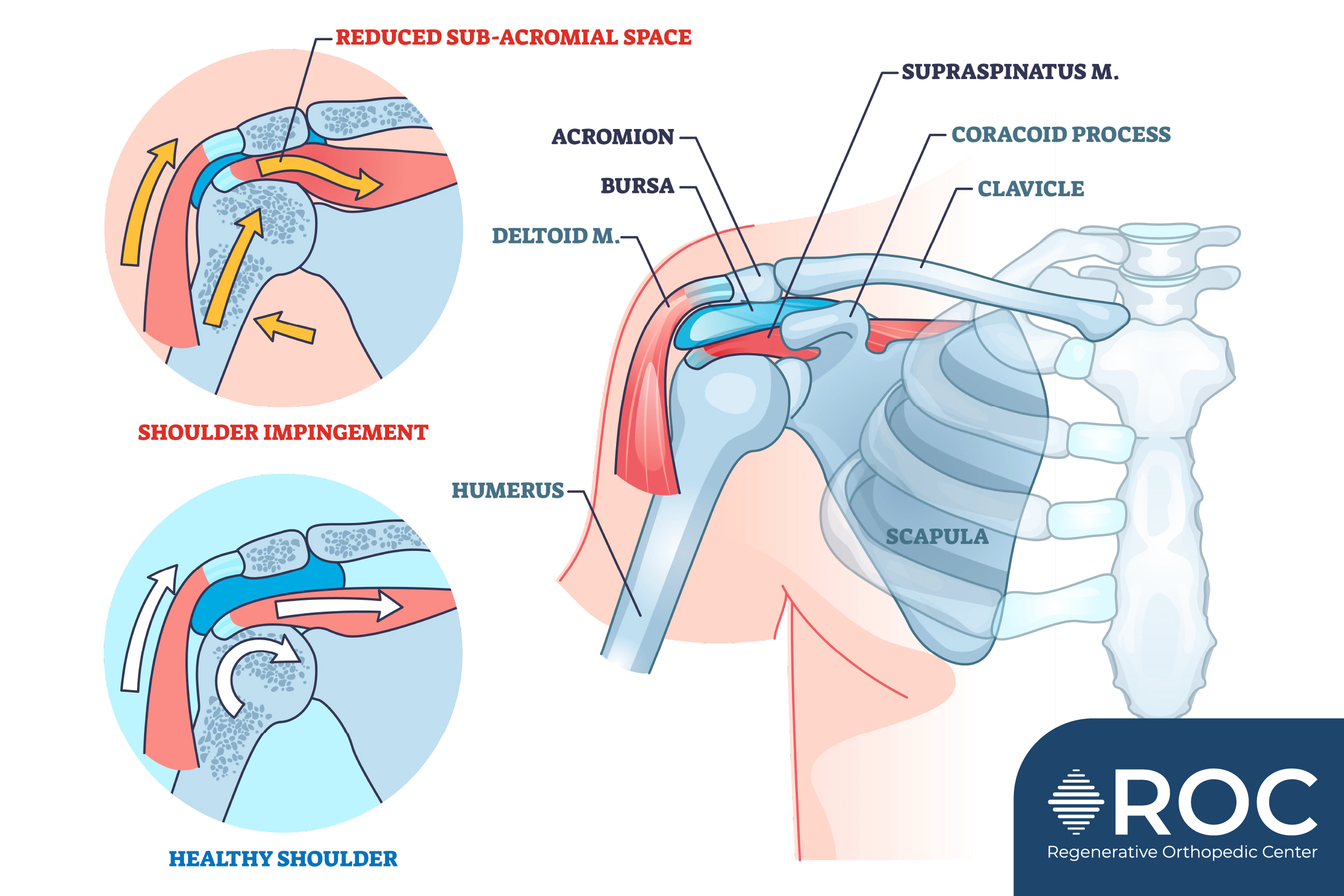
Shoulder impingement often develops from a combination of factors rather than a single cause. Understanding these contributing elements is helpful for both prevention and effective treatment. The primary mechanism involves the narrowing of the subacromial space, the area between the acromion (a bony projection from the shoulder blade) and the humeral head (the top of the arm bone). Within this space lie the rotator cuff tendons and the subacromial bursa. When this space becomes constricted, these soft tissues can get pinched, leading to inflammation and pain.
- Repetitive Overhead Activities
- One of the most common culprits behind shoulder impingement is repetitive overhead arm movement.
- This is particularly prevalent in athletes involved in sports such as baseball (pitching), swimming, tennis, and volleyball.
- Occupations requiring frequent overhead work, such as painting, construction, or stocking shelves, may also put individuals at a higher risk.
- The constant elevation of the arm can lead to friction and compression of the rotator cuff tendons against the acromion, gradually causing irritation and inflammation.
- Anatomical Factors
- Individual anatomical variations can predispose certain people to shoulder impingement.
- The shape of the acromion is a significant factor. There are several types of acromial shapes: flat, curved, and hooked.
- Individuals with a curved or hooked acromion have a naturally smaller subacromial space, generally making them more susceptible to impingement.
- Bone spurs, which are bony growths that can develop on the underside of the acromion, can further reduce this space.
- Poor Posture and Biomechanics
- A rounded shoulder posture, often seen in individuals who spend long hours at a desk or using electronic devices, can cause the shoulder blade to tilt forward.
- This tilting shrinks the subacromial space and may lead to impingement.
- Age-Related Degeneration
- As we age, the tendons and other soft tissues in our bodies naturally undergo degenerative changes.
- The rotator cuff tendons can become less elastic and more prone to wear and tear over time.
- This age-related degeneration, combined with years of normal shoulder use, can lead to fraying and weakening of the tendons, making them more vulnerable to impingement.
- Calcium deposits within the tendons, a condition known as calcific tendinitis, can also occur with age, further contributing to pain and reduced space within the shoulder joint.
- Acute Injury
- While often a long-term or chronic condition, shoulder impingement can also be triggered by an acute injury.
- A fall onto the shoulder, a direct blow, or a sudden, forceful movement can cause inflammation and swelling within the subacromial space, leading to acute impingement.
- Other Contributing Factors
- Several other factors can contribute to the development or exacerbation of shoulder impingement, including inflammatory conditions, insufficient recovery times, lack of flexibility, and rotator cuff muscle weakness.
Understanding these diverse causes highlights the importance of a thorough diagnosis to identify the specific factors contributing to an individual’s shoulder impingement. This comprehensive assessment allows for the development of a targeted and effective treatment plan, addressing not just the symptoms but also the underlying causes of the condition.
Symptoms of Shoulder Impingement
Recognizing the symptoms of shoulder impingement is the first step toward seeking appropriate medical care and initiating effective treatment. The symptoms can vary in intensity and presentation depending on the severity of the condition, but they generally revolve around pain, weakness, and limited range of motion.
- Pain
- Pain is typically the most prominent symptom of shoulder impingement.
- It may manifest in the front and side of the shoulder, often radiating down the arm towards the elbow.
- The pain is usually described as a dull ache at rest, which sharpens and intensifies with certain movements.
- Common activities that may exacerbate the pain include reaching or lifting overhead, reaching behind the back, sleeping on the affected side, and sudden movements.
- Initially, the pain might be mild and intermittent, only occurring during specific activities.
- However, as the condition progresses, the pain can become more constant, even present at rest, and may interfere with daily activities and sleep.
- Weakness
- Along with pain, weakness in the affected arm is a common symptom, typically resulting from the inflammation and irritation of the tendons.
- Attempting to lift or carry objects, especially overhead, may exacerbate this weakness.
- If the impingement leads to a partial or full tear of the rotator cuff, the weakness may become more pronounced and persistent.
- Stiffness and Limited Range of Motion
- Shoulder impingement can lead to a noticeable reduction in the shoulder’s range of motion.
- This stiffness is often a protective mechanism, as the body tries to avoid movements that cause pain.
- Patients may find it difficult to fully raise their arm overhead, reach across their body, or rotate their arm outwards.
- The limitation in motion can be particularly frustrating for athletes or individuals whose professions require a full range of shoulder movement.
- Clicking, Popping, or Grinding Sensations
- Some individuals may report clicking, popping, or grinding sensations within the shoulder joint during movement.
- These sounds can be indicative of the tendons or bursa rubbing against the bony structures as the arm moves through its range of motion.
- While not always painful, these sensations can suggest mechanical irritation within the joint.
- Tenderness to Touch
- Tenderness is often localized over the inflamed tendons or bursa, indicating active inflammation.
- Night Pain and Sleep Disturbance
- Night pain can be severe enough to wake individuals from sleep or make it difficult to find a comfortable sleeping position.
- This chronic sleep disruption can impact an individual’s overall well-being and recovery.
If experiencing these symptoms, it may be time to seek medical evaluation. Early diagnosis and intervention can help prevent the condition from worsening. A shoulder surgeon can accurately diagnose shoulder impingement and differentiate it from other conditions that present with similar symptoms, ensuring the most appropriate course of action.
Treatment for Shoulder Impingement
The treatment approach for shoulder impingement is typically conservative in the initial stages, focusing on reducing pain and inflammation, restoring range of motion, and strengthening the surrounding muscles. Surgical intervention may be considered after a prolonged period of unsuccessful conservative management. An experienced shoulder specialist can evaluate the condition and help guide the most appropriate treatment path.
Conservative Management
Conservative treatment methods aim to reduce symptoms and improve shoulder function without surgical procedures.
Rest and Activity Modification
Rest doesn’t necessarily mean complete immobilization, but rather avoiding or reducing overhead activities, heavy lifting, and repetitive arm movements that trigger symptoms. For athletes, this may involve a temporary break from their sport or modifying their technique. For individuals in occupations requiring overhead work, adjustments to work tasks or ergonomic changes may be necessary. The goal is to give the inflamed tissues an opportunity to heal without constant irritation.
Ice and Heat Therapy
Applying ice packs to the affected shoulder for 15-20 minutes several times a day can help reduce inflammation and pain. Once the initial inflammation subsides, some individuals find alternating between ice and heat beneficial, or using heat therapy before exercises to warm up the muscles and improve blood flow.
Nonsteroidal Anti-Inflammatory Drugs (NSAIDs)
Over-the-counter NSAIDs are commonly used to reduce pain and inflammation. It’s important to use these medications as directed and be aware of potential side effects, especially with long-term use.
Physical Therapy
Physical therapy is a key component of shoulder impingement treatment. A physical therapist can design a personalized exercise program generally aimed at:
- Restoring Range of Motion: Gentle stretching exercises are used to improve flexibility and regain range of motion in the shoulder joint.
- Strengthening Rotator Cuff Muscles: Specific exercises target the four rotator cuff muscles to improve their strength, endurance, and coordination.
- Posture Correction: Physical therapists may also provide guidance on maintaining proper posture, especially during daily activities and work.
- Technique Modification: For athletes or individuals whose impingement is related to specific activities, the physical therapist can help analyze and correct movement patterns to reduce stress on the shoulder.
Injections
If pain and inflammation persist despite rest, NSAIDs, and physical therapy, a corticosteroid injection into the subacromial space may be considered. Corticosteroids are powerful anti-inflammatory medications that can provide significant, albeit temporary, pain relief. Sometimes, other injections such as PRP (platelet rich plasma) can be helpful.
Surgical Intervention
Surgical treatment for shoulder impingement is typically reserved for cases where conservative management has failed to provide adequate relief. The primary goal of surgery is to increase the space within the subacromial area to decompress the rotator cuff tendons and bursa. The most common surgical procedure is subacromial decompression which is performed with a minimally invasive arthroscopic technique.
Arthroscopic Subacromial Decompression (ASAD)
Arthroscopic surgery is a minimally invasive procedure performed through small incisions using a tiny camera (arthroscope) and specialized instruments. During an ASAD, the surgeon may remove inflamed bursa and reshape the acromion to increase the subacromial space. Bone spurs may also be removed.
Arthroscopic surgery may result in less pain, smaller scars, and a faster recovery compared to traditional open surgery. After surgery, a period of rehabilitation with physical therapy is often important to regain strength, range of motion, and function. The recovery process often takes many months, and in some cases up to a year.
Post-Treatment Considerations and Prevention
Regardless of the treatment approach, ongoing care and preventive measures are important to maintain shoulder health and help prevent recurrence. This may include the following strategies:
- Continued Exercise Program: Adhering to a home exercise program, focusing on strengthening and flexibility.
- Proper Technique: Ensuring correct form during sports and work activities to minimize stress on the shoulder.
- Ergonomic Adjustments: Optimizing workstations and daily environments to promote good posture and reduce strain.
- Warm-up and Cool-down: Performing adequate warm-up exercises before physical activity and cool-down stretches afterward.
- Listen to Your Body: Paying attention to early signs of pain or discomfort and addressing them promptly.
Summary
Shoulder impingement is a common and painful condition that can significantly impact an individual’s quality of life. Understanding its causes, recognizing its symptoms, and knowing the available treatment options are steps toward effective management and recovery.
Many shoulder impingement cases respond favorably to conservative treatments, including rest, activity modification, anti-inflammatory medications, and a comprehensive physical therapy program. For those few cases where conservative measures prove insufficient, surgical intervention may be recommended to create more space within the shoulder joint.
Frequently Asked Questions
What is the difference between shoulder impingement and a rotator cuff tear?
Shoulder impingement may occur when the rotator cuff tendons or bursa are pinched or compressed in the shoulder joint, leading to inflammation and pain. A rotator cuff tear, on the other hand, is a structural injury where one or more of the rotator cuff tendons are torn, either partially or completely.
Can shoulder impingement heal on its own?
In some mild cases, shoulder impingement may improve with rest and activity modification. However, for most cases, especially those with persistent pain or underlying anatomical factors, active treatment such as physical therapy, anti-inflammatory medications, injections, and lifestyle changes may be necessary for full recovery and to prevent recurrence.
How long does it take to recover from shoulder impingement?
The recovery time for shoulder impingement varies widely depending on the severity of the condition, the individual’s adherence to treatment, and whether surgery is required. For conservative treatment, improvement can often be seen within 3 months of consistent physical therapy and activity modification. If surgery is necessary, full recovery may take anywhere from 6 months to a year.
Is surgery always necessary for shoulder impingement?
Surgery is not always necessary. Surgery is typically considered only after a prolonged period of dedicated conservative management has failed to provide sufficient relief, or if there is a rotator cuff tear that requires surgical repair.
What role does physical therapy play in treating shoulder impingement?
Physical therapy typically plays an important role in reducing pain, restoring range of motion, and strengthening the muscles around the shoulder. A physical therapist can guide you through exercises to improve flexibility, strengthen the rotator cuff and scapular stabilizer muscles, correct posture, and modify movement patterns.
Key Takeaways
- Shoulder impingement occurs when rotator cuff tendons or the bursa are compressed in the shoulder joint, leading to pain and inflammation.
- Repetitive overhead activities, poor posture, anatomical factors, and age-related degeneration are primary contributors.
- Initial treatment focuses on rest, ice, NSAIDs, and physical therapy. If conservative methods fail, surgical intervention may be considered.
- Maintaining good posture, strengthening shoulder muscles, and using proper technique during activities can help prevent impingement.
If you’re dealing with shoulder impingement symptoms, schedule a consultation with one of our experts today.